
Stress Fractures in Runners: Why They Happen and How to Recover the Right Way

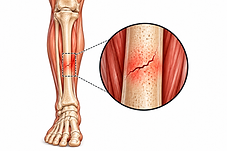
A physical therapist's guide to what causes stress fractures in runners of every age, how a stress fracture differs from shin splints, and how to safely return to running once one has been properly diagnosed.
A stress fracture in a runner almost never comes out of nowhere. It builds quietly over weeks of training before the pain finally forces a stop, usually along the shin, the top of the foot, or occasionally the hip. If you have been training for a race, ramping up mileage, or getting back into running after time off and you are feeling a nagging, localized ache that gets worse with activity and eases with rest, it is worth understanding what is actually happening in the bone and why it is not something to run through.
What a stress fracture actually is
A bone stress injury sits on a spectrum. It starts as a stress reaction, a kind of early bone bruising, and can progress toward a true stress fracture if the loading continues unchanged. It happens when a bone is being asked to remodel and rebuild faster than it actually can. Every time you run, your bone experiences microscopic damage and then repairs itself, and under normal training that process keeps the bone strong. A stress injury develops when the damage outpaces the repair.
This is different from shin splints, a term often used loosely for any shin pain. True shin splints, known clinically as medial tibial stress syndrome, tend to cause pain along a broader stretch of the shin bone and usually ease somewhat once you are warmed up. A stress fracture is more localized, more pinpoint to the touch, and tends to get worse rather than better as you keep moving. The distinction matters because the two are managed differently, and a proper diagnosis, usually starting with a clinical exam and imaging when needed, is the only reliable way to tell them apart.
The tibia, the larger bone in the lower leg, is the single most common site for a running-related stress fracture at any age. The metatarsals in the foot and the navicular bone are also frequent locations.
What contributes to stress fractures in young and adolescent runners
Growing bone is more vulnerable to this kind of injury because it is still immature. A 2024 review in the Journal of the Pediatric Orthopaedic Society of North America found that specializing in a single sport before age 12, and training more than eight months out of the year, substantially raises a young athlete's risk of a stress fracture. The same review pointed to two other contributors that are easy to miss in a young athlete: low vitamin D, and underfueling relative to how much the athlete is training, a pattern known as relative energy deficiency in sport, or RED-S. Parents of young runners and multi-sport athletes should treat a persistent, localized ache as a reason to get it looked at rather than something to push through until the season ends.
What contributes to stress fractures in adult runners
In adult runners the bone itself is mature, but a version of the same fueling problem shows up. A 2023 review in Operative Techniques in Sports Medicine found that once the energy available to the body drops below roughly 30 calories per kilogram of lean body mass per day, the systems that keep bone strong start to break down. The same review found that increasing training volume without also increasing food intake measurably slows the body's metabolism within a matter of weeks. This means the injury is rarely caused by one hard workout. It is usually training load climbing faster than the fuel and recovery supporting it, whether that is a sudden jump in weekly mileage, training for a first marathon on a compressed timeline, or returning to running too quickly after time off.
Preventing a stress fracture
Prevention comes down to three things working together rather than any single fix. Training volume needs to increase gradually, generally no more than about 10 percent added per week, so bone has time to adapt to new load. Fueling needs to genuinely match the work being done, particularly during heavier training blocks, since a calorie deficit is one of the clearest risk factors identified in the research above. Strength through the hips, glutes, and calves needs to be built and maintained so that the muscles around the bone are absorbing their share of the impact instead of leaving the bone to do it alone.
Recovering from a diagnosed stress fracture
Once a stress fracture is properly diagnosed, rushing the return to running is one of the most common ways people end up injured again. A 2024 scoping review of return-to-run criteria after a tibial bone stress injury found the safest markers to watch for before resuming running are pain-free walking and daily activity, no tenderness directly over the bone itself, and strength in the injured leg back to at least 75 to 80 percent of the uninjured side. From there, running should be reintroduced through structured walk-run intervals that build distance before speed, not the other way around.
Just as important, and often skipped, is identifying and correcting whatever set the injury off in the first place, whether that is a training error, a fueling gap, or a mechanical issue further up the chain at the hip or ankle. Clearing the fracture and clearing the cause are two different jobs, and both need to be done before you are truly ready to train again.
When to see a physical therapist
If you are dealing with bone-deep, localized pain in your shin, foot, or hip that has not been formally diagnosed, that is the first step, not more rest and hoping it resolves on its own. And if you have already been cleared by imaging and are unsure how to safely rebuild your mileage, a structured, one-on-one return-to-running plan is exactly the kind of problem a sports-trained physical therapist should be solving with you rather than a generic printout.
At Enhance Physical Therapy, every evaluation is a full 60 minutes, one-on-one, with a Fellowship-trained physical therapist, not split across multiple patients at once. That time is what allows us to actually find what is driving an injury like this, whether it is a training pattern, a fueling issue, or the way you move through your hip and ankle, rather than just treating the spot that hurts. You can schedule a visit at https://enhancept.janeapp.com/.
Dr. Doug Ashton, DPT, FAAOMPT
Owner, Enhance Physical Therapy
Sources
Schreiber, V.M. Stress fractures and overuse injuries in children and adolescents (2024), Journal of the Pediatric Orthopaedic Society of North America. https://www.jposna.com/article/S2768-2765(24)00855-1/fulltext
Kim, D.R. and Weber, K. Relative Energy Deficiency in Sport (RED-S) and Bone Stress Injuries (2023), Operative Techniques in Sports Medicine. https://www.sciencedirect.com/science/article/abs/pii/S1060187223000515
Criteria and Guidelines for Returning to Running Following a Tibial Bone Stress Injury: A Scoping Review (2024), Sports Medicine. https://link.springer.com/article/10.1007/s40279-024-02051-y


Comments